
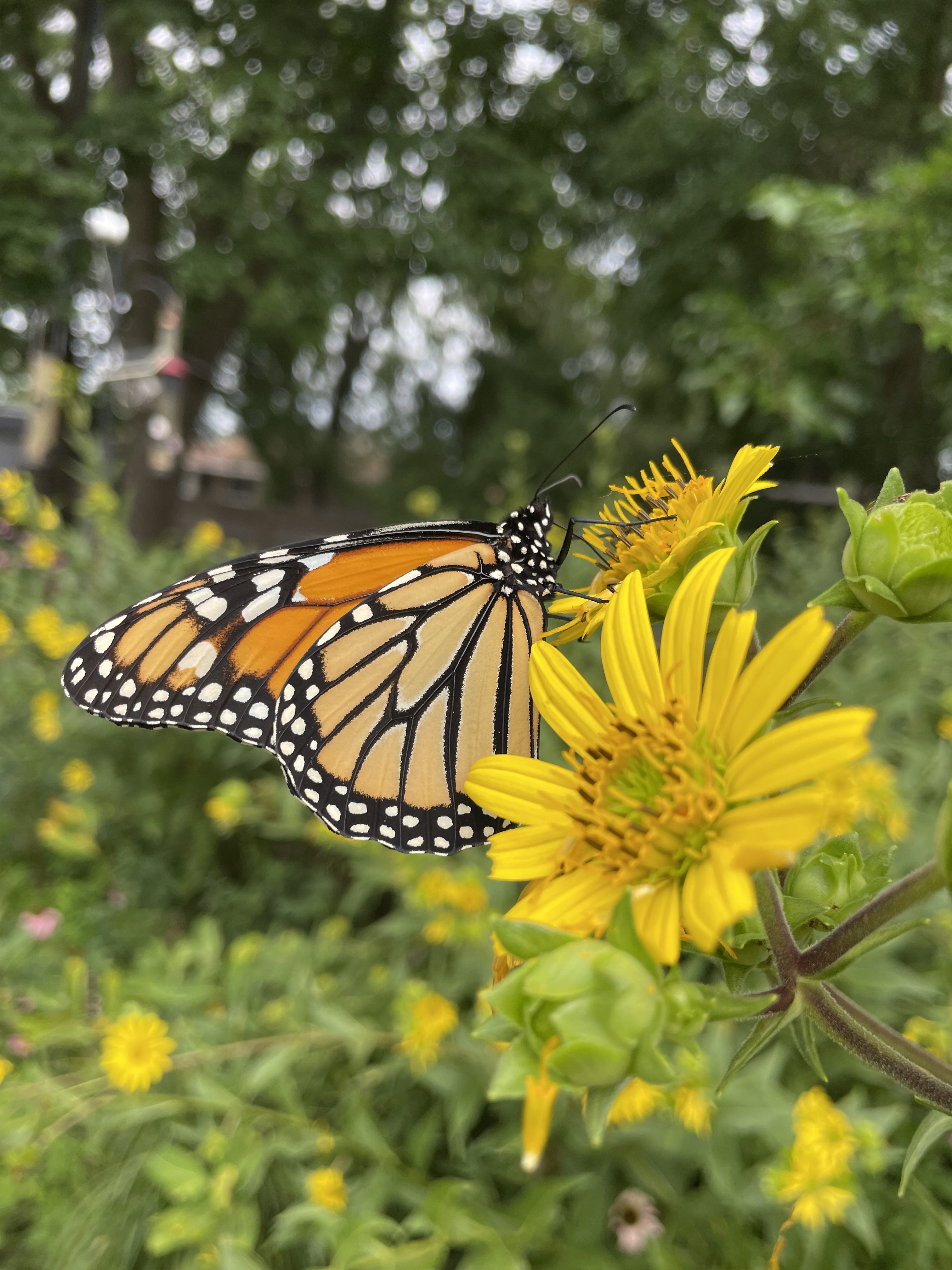
When should you look for monarchs? Where should you go? And how can families help them along their journey? Jen Meilinger of the Michigan Butterfly Network shares what families should know about one of Michigan’s most remarkable fall migrations.
By Jen Meilinger, Research Director, Kalamazoo Nature Center
Each fall, monarch butterflies travel through Michigan on an extraordinary journey south. Along the way, they follow Great Lakes shorelines, gather in trees to rest and stop in flower-filled habitats to refuel.
For Michigan families, that means a September beach day, nature walk or weekend in the Upper Peninsula can come with an unexpected bonus: the chance to watch monarch migration in action.
Here’s what to know before heading out.

When is peak monarch migration along Lake Michigan?
Monarch migration in Michigan takes place from late August through early October, with September being the best time to spot monarchs migrating in greater numbers.
Where should families go to witness the migration?
Monarchs utilize the winds in their travels, so visiting the Great Lakes shorelines during the migration period is one of the best ways to observe this phenomenon. A family beach trip could also pass for a monarch migration viewing party!
During migration, monarchs will roost in large quantities in trees overnight or while waiting for better weather.
The Peninsula Point Lighthouse on the Stonington Peninsula in the Upper Peninsula has been studied for decades as one of these roosting sites that monarchs keep coming back to before they journey along Lake Michigan. The lighthouse lies within the Hiawatha National Forest and is open to the public year-round.
Wide expanses of nectar sources, such as native prairies, also offer opportunities to see monarchs making pit stops to fuel up before continuing their journey.
The Prairie Pathway Trail through the Emma Pitcher Prairie at the Kalamazoo Nature Center is an excellent spot to catch butterflies feeding and on the wing.

How does the weather influence what families are likely to see?
Butterflies are cold-blooded, so they rely on the sun’s warmth to give them energy.
If the sun is shining and temperatures are warm with good winds out of the north, you’re likely to see some monarchs.
You can still see monarchs and other butterflies on cloudier days as long as daytime temperatures are on the warmer side. Stick to days where daytime temperatures are at least 60 degrees Fahrenheit or above. Anything cooler than that and the butterflies are likely not flying.
What misconceptions do people have about monarch migration?
Many people don’t realize that during the southward migration, each butterfly is making that entire journey to Mexico. That’s up to 3,000 miles in some instances for a single insect. Incredible!
The northward migration is different. It takes several generations of monarchs traveling north to get back to Michigan.
The last generation born in northern regions, the migrating cohort, is the longest-lived of the species, living for months compared with their predecessors, which typically live only two to six weeks.
Not all monarchs migrate. Monarchs in areas such as South Florida and Southern California are considered year-round residents.

What simple things can families do to support monarch conservation at home?
Plant native plants!
Providing host plants and nectar plants will help monarchs as well as other butterflies, bees and birds.
For monarchs in particular, their host plant, the plant where they lay their eggs, is milkweed. Two great options are Common Milkweed and Butterfly Weed.
Great nectar plant options include:
- Purple Coneflower
- Black-eyed Susans
- Liatris
- Goldenrod
- Ironweed
There are many options for nectar plants, but having plants with overlapping bloom times makes nectar available all season long and helps keep butterflies coming to your home gardens.
If possible, avoid using pesticides in your yard. A lot of pesticides are broad and will impact insects outside of the targeted pest species.
And get involved in community science!
Most of what we know about monarch migration is because of community-driven data collection. Opportunities to get involved in butterfly conservation are available through organizations such as the Michigan Butterfly Network, Xerces Society, Monarch Watch and Monarch Joint Venture, among many others.
Butterflies are excellent environmental indicators, and their population trends can tell us about the health of the world around us. Any small steps we can take in our own lives to help will not only benefit monarchs but all wildlife we share space with.

Are there migration counts, tagging events or educational opportunities families can join?
Monarch tagging is a community science project you can do with your family at home or at a local natural area. Monarch Watch has resources for families interested in getting involved.
Michigan also has a number of butterfly and monarch events throughout the season. Some opportunities include guided butterfly hikes at the Kalamazoo Nature Center in July, August and September; the annual Monarch Festival hosted by the Berrien County Conservation District; Monarch Day at John Ball Zoo; the Monarch and Hummingbird Festival hosted by Huron-Clinton Metroparks; the Monarch Migration Festival at Leslie Science & Nature Center in Ann Arbor; and Monarch Tagging & Release events in September at Boulder Ridge Wild Animal Park.
Many other events and opportunities exist, so check individual organizations for current dates and details before making plans.
The Michigan Butterfly Network, a program of the Kalamazoo Nature Center, also hosts free virtual butterfly-monitoring training each spring and helps community scientists monitor butterflies in public natural spaces throughout Michigan and northern Indiana.
Monitoring takes place from spring through fall, and no experience is required to participate.

Make Monarch Migration Part of Your Fall
You don’t necessarily need a special trip to experience monarch migration.
Head to a Great Lakes beach in September. Walk through a native prairie on a warm afternoon. Look closely at the flowers on your next family hike. Or simply spend some time watching what’s visiting your own backyard.
Once you know what to look for, those flashes of orange overhead become a reminder that something extraordinary is happening all around us.
And perhaps the best part is that families don’t have to stop at watching. Planting milkweed, creating sources of nectar, participating in butterfly monitoring or tagging monarchs can turn a single fall sighting into a much longer connection with Michigan’s natural world.

About the Author
Jen Meilinger is a mother, gardener, avid reader and nature explorer. Her career has led her to the Kalamazoo Nature Center as Research Director, where she oversees the organization’s environmental research efforts. Her work includes population and habitat monitoring, avian research with the Kalamazoo Valley Bird Observatory and community-based butterfly monitoring with the Michigan Butterfly Network, both programs of the Kalamazoo Nature Center.
What she loves most about her work is helping bridge the gap between academic research and community involvement by connecting people to conservation through community science opportunities, educational programming and volunteering.
Happy butterflying!




Leave a Reply